A new arXiv preprint by Sergey Ostapchenko, Tanguy Pierog and Günter Sigl studies how the QGSb hadronic-collision generator changes two key extensive-air-shower observables and compares the shifts with accelerator data.
A new arXiv preprint is adding detail to a long-running problem in cosmic-ray physics: how much the predictions for extensive air showers depend on the hadronic-interaction model used in the simulation.
Posted on June 18, 2026, the paper by Sergey Ostapchenko, Tanguy Pierog and Günter Sigl studies a Monte Carlo generator called QGSb and asks how it changes two observables central to composition studies: the depth of shower maximum and the number of muons reaching ground level.
The authors say they look not only at the observable shifts themselves, but also at the underlying physics mechanisms behind each modification they consider. They also compare the model changes with relevant accelerator data, which is important because shower predictions are only as reliable as the collision model underneath them.
Why the result matters
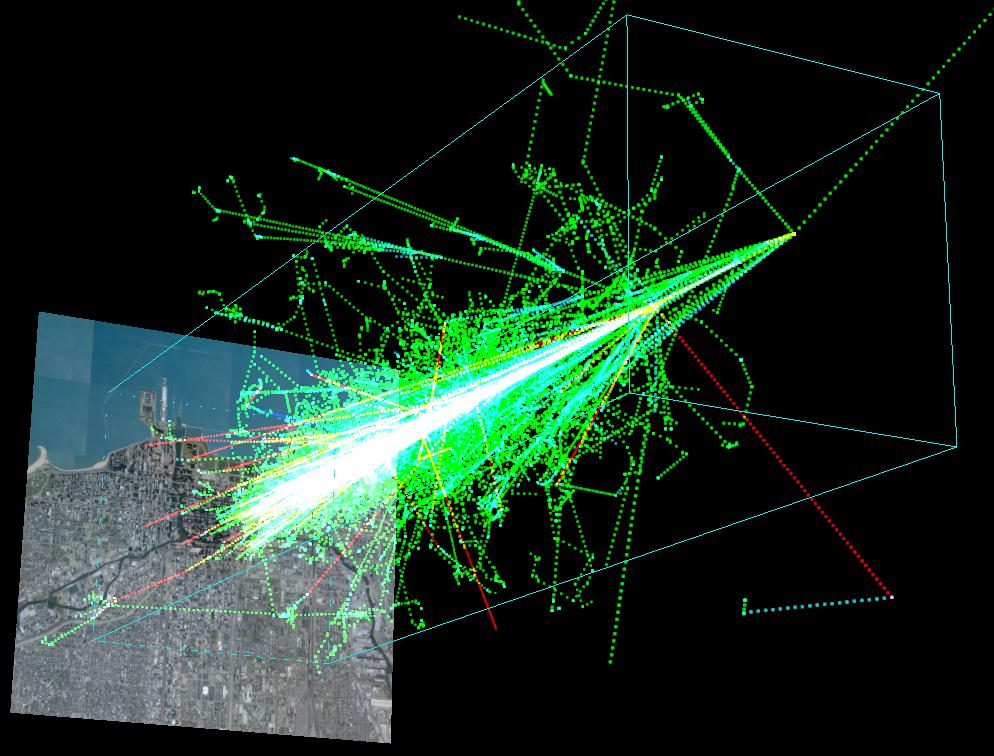
Extensive air showers are cascades of secondary particles created when a very high-energy cosmic ray strikes the atmosphere. Researchers use those cascades to infer the nature of the original particle, but the inference is limited by uncertainty in the hadronic physics built into the simulation.
Two of the most important observables are the shower maximum depth, which tracks where the cascade develops most strongly, and the muon number at ground level. Both are widely used in cosmic-ray composition work, and both are sensitive to modeling assumptions.
Muon-number predictions in particular have been a weak point in air-shower modeling for years. That makes any paper that tests a new generator against that observable immediately relevant to how the field interprets data.
What QGSb is building on
The new preprint fits into a longer modeling program from the same author. A related arXiv paper from April 1, 2026 also used QGSb to study uncertainties in the muon content of extensive air showers and to discuss accelerator constraints.
The June paper broadens that earlier effort. Instead of focusing only on muons, it explicitly includes shower maximum depth as a second observable, making the uncertainty study more directly relevant to composition analyses that rely on both quantities.
Earlier QGSJET-III papers from 2024 provide the background for this line of work. One laid out the formalism of the hadronic-interaction model, and another described particle production and extensive-air-shower characteristics. The new QGSb study extends that framework rather than appearing in isolation.
What the authors say they tested
According to the research packet, the paper examines model uncertainties in showers initiated by high-energy cosmic rays in the atmosphere. It looks at how changes in the generator affect the two observables and at what physics mechanisms drive those changes.
The accelerator-data cross-check matters because it anchors the shower modeling to known collision constraints. In practice, that helps show whether a change that improves or shifts air-shower predictions remains compatible with particle-physics data.
The paper does not, at least in the abstract-level material available now, report the exact numerical shifts in shower maximum depth or muon count. That means the key new point is the direction of the study and the observables under test, not yet a fully quantified claim in the public summary.
What is known now
The current news peg is the public posting of the preprint to arXiv on June 18, 2026 at 13:36 UTC. The authors are Sergey Ostapchenko, Tanguy Pierog and Günter Sigl, and the work is identified as a fresh treatment of model uncertainty in extensive air showers.
The research packet says no earlier materially reported version of this specific paper surfaced before the arXiv posting. That makes the preprint itself the first public milestone for the story.
For cosmic-ray researchers, the issue is not abstract. Shower observables are among the main inputs used to infer composition, and the biggest uncertainty often comes from the hadronic model rather than the measurement itself. Any re-evaluation of those model errors can change how simulation results are read.
What remains open
The full paper may eventually answer questions the abstract does not. The most obvious are whether QGSb produces a specific shift in shower maximum depth or muon number, and how large those shifts are under the different modifications the authors consider.
It is also not yet clear whether QGSb will be released publicly or how the model differs technically from previous generators. Those details matter for other groups that may want to test or compare the framework.
For now, the paper should be treated as a developing contribution to a field where model uncertainty is a central limitation. The immediate takeaway is that the authors are trying to pin down how much of cosmic-ray composition inference depends on particle physics assumptions, and how much survives contact with accelerator data.
Revision note
Initial automated publication.