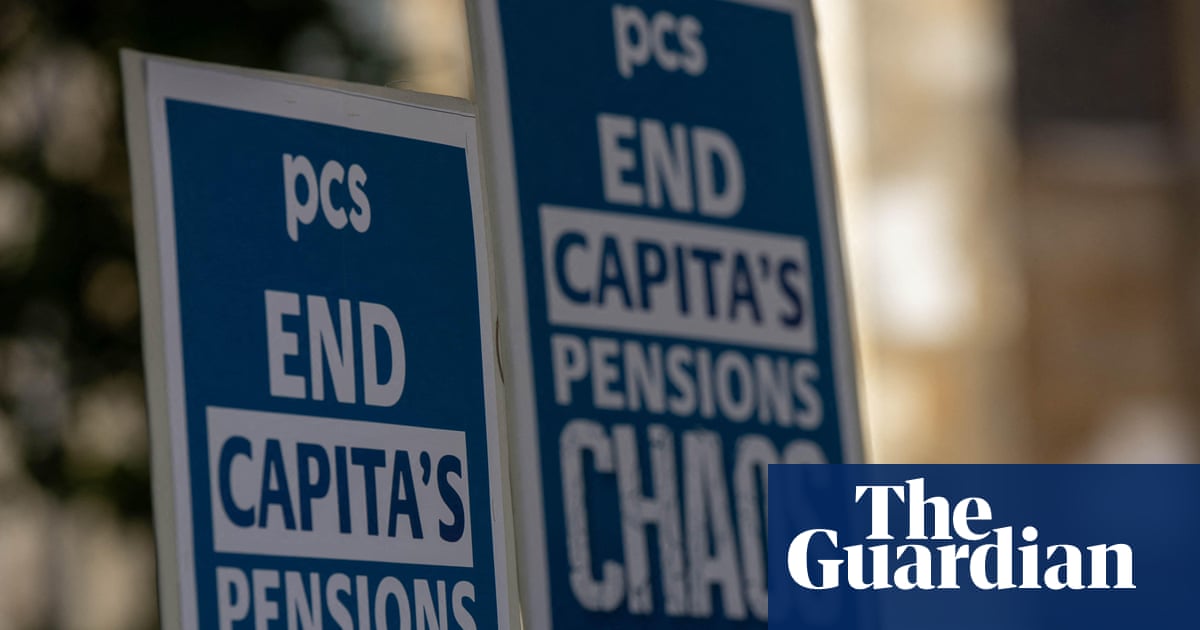
Capita has warned that failures in its Civil Service Pension Scheme work will reduce 2026 adjusted operating profit by up to £40m and cash flow by up to £50m, as the government withholds payments and seeks to recover public costs.
Capita has warned that failures in its work on the Civil Service Pension Scheme will reduce 2026 adjusted operating profit by £25m to £40m and cut cash flow by £35m to £50m.
The outsourcing group said the hit reflects extra staffing, remediation work and the fact that earlier cost-efficiency assumptions were not met. Chief executive Adolfo Hernandez said the service on the scheme has not been good enough and that it remains the company's top priority.
The warning adds a financial cost to a long-running operational failure that has drawn political criticism and left thousands of scheme cases unresolved. The company administers the scheme under a public contract, making the problems a matter of both corporate performance and public administration.
Profit warning
Capita said the financial impact will fall in 2026 rather than on the current year. The group did not suggest the issue was confined to a one-off charge, instead pointing to continued remediation work and higher support costs as it works through the backlog.
The company said its original efficiency assumptions for the contract did not hold up once the service problems became more serious. That meant Capita had to put in more people and more manual intervention than expected to stabilise the operation.
The scale of the warning matters because it comes from a business that has spent years trying to convince investors that it can deliver steadier margins and cash generation from public-sector work. A £25m to £40m operating profit hit is large enough to reshape expectations for the year.
The Times reported that Capita shares fell 20.65% on the news, closing at 221p. That reaction suggests investors see the issue as more than a temporary glitch in a single contract.
Pension backlog
The contract problems have been visible to scheme members for months. The core issue is a backlog in retirement and bereavement processing, which has left people waiting for pension quotations and decisions at moments when speed matters most.
The Guardian reported that more than 6,700 retirement quotations and 4,100 bereavement cases were still outstanding at the end of last month. Those are not abstract service metrics: they represent delayed income for people trying to retire and delayed administration for families dealing with deaths.
The service failure has already become a political issue because the Civil Service Pension Scheme is a public scheme and Capita is being paid to run it on the government's behalf. Parliamentarians have questioned how the backlog was allowed to build up, and the operational failure has become a test of whether outsourced administration can meet basic service standards.
Hernandez's comments suggest management is still treating the recovery effort as the company's immediate priority. But the scale of the outstanding work means the remediation itself is part of the cost problem, not just the fix.
Government response
The government has also moved to limit its own exposure. The Guardian reported that nearly £10m in payments had been withheld because of service shortfalls, effectively using contract leverage to respond to the failure.
Public costs have not stopped there. The HMRC deputy chief executive leading a taskforce estimated that bringing in civil servants to help at £12.5m. The government has also issued £15.6m in interest-free hardship loans to 2,700 affected members.
Paymaster General Nick Thomas-Symonds has pledged to recover every penny of public money spent on the failure. That creates the prospect of further financial pressure on Capita if ministers decide to pursue repayment or broader contractual remedies.
The dispute therefore sits at the intersection of outsourcing, taxpayer funding and member harm. The company is dealing with a contract repair bill while government departments and officials are trying to contain the wider cost of service failure.
Wider significance
Capita is one of the best-known UK outsourcing groups, so the fallout goes beyond a single pension contract. A visible failure in a public scheme feeds wider scrutiny of the company's ability to manage government work reliably.
The problem also highlights how an operational miss can turn into a profit warning. What began as a service backlog has now become a forecast earnings hit, a cash-flow problem, a share-price shock and a political issue.
The company said the pension scheme work was not being delivered well enough, but it has not given a fresh timetable for when service levels will fully normalize. That leaves the market and ministers looking for evidence that the backlog is shrinking, not just being managed.
For now, the main questions are how quickly Capita can clear the unresolved cases, whether more public money will be recovered, and whether the contract will be judged a lasting drag on the group's outlook.
What happens next
Capita will continue working through the backlog and is expected to give more detail on the financial hit in future updates.
Ministers are likely to keep pressing for reimbursement of public costs and for service improvements that can be measured against the current backlog.
Parliamentary scrutiny is also likely to continue, especially if the scheme remains slow to recover or if the contract is seen as having shifted too much risk onto members and the public sector.
The company now has to prove that the £25m to £40m profit hit and the £35m to £50m cash-flow impact remain within the range it has set. If the remediation takes longer or costs more than expected, the damage could extend further into 2026.
Revision note
Initial automated publication.