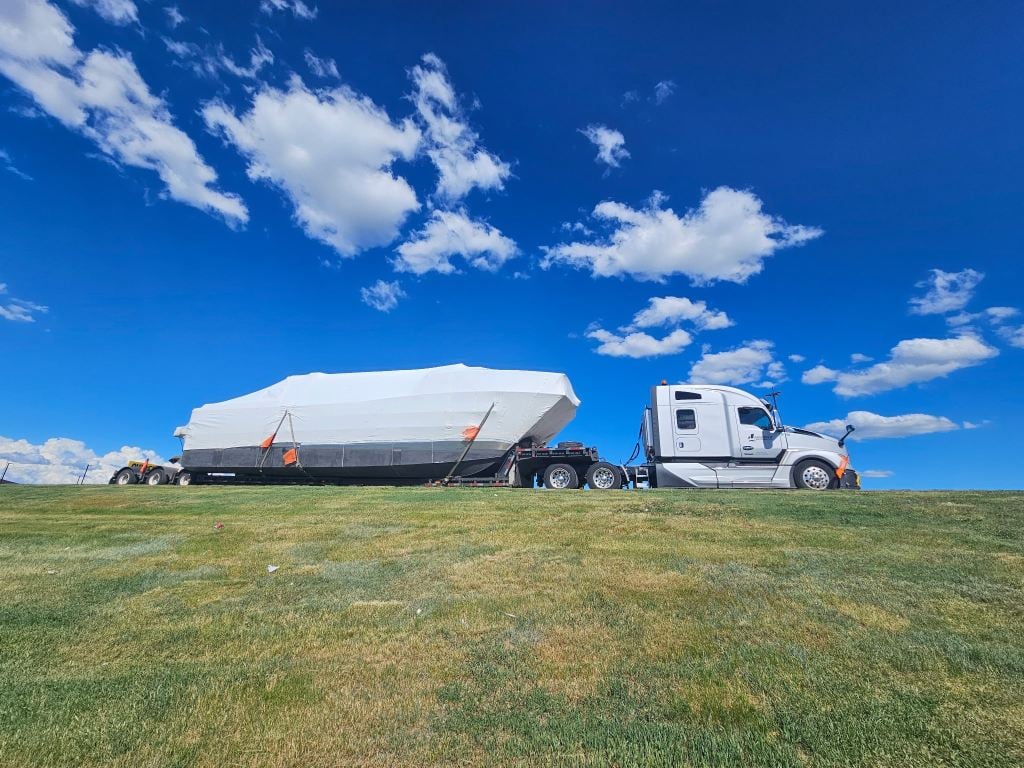
Connecticut’s new Sound Outlook research vessel was trucked cross-country after Strait of Hormuz shipping disruptions derailed its planned ocean route, delaying its arrival for Long Island Sound monitoring.
Connecticut’s new research boat for Long Island Sound did not come in by water. Instead, the 48-foot vessel known as the Sound Outlook was hauled across the country by truck after shipping disruption in the Strait of Hormuz made the original plan by sea impractical.
The unusual detour turned a routine public-works delivery into a reminder of how global shipping problems can reach well beyond the Middle East. The boat was built in Washington state by BRIX Marine and was expected to travel by cargo ship, with a route that would have gone through the Panama Canal before reaching Connecticut.
How the route changed
According to the reporting, the vessel’s planned ocean trip became too uncertain because of the disruption in the Strait of Hormuz. Rather than keep waiting for a sea route to open up, BRIX Marine shifted to a land route and moved the boat cross-country.
That required partially disassembling the aluminum catamaran, loading it as an oversize shipment and using pilot cars, route restrictions and cranes to get it to its destination. After the long truck move, the vessel was reassembled at Hays Haven Marina in Chester.
From there, the Sound Outlook was delivered to the Connecticut Department of Energy and Environmental Protection’s marine headquarters in Old Lyme.
What the boat is for
DEEP says the Sound Outlook will expand Long Island Sound water-quality monitoring. The agency expects it to collect data on oxygen, bacteria, water temperature and other conditions that affect the estuary.
The vessel also gives the state more capacity than the older RV John Dempsey. The new boat has twice the lab space, a higher top speed and the ability to work in waters as shallow as two feet, which should make it useful for additional work such as eelgrass monitoring.
That matters because Long Island Sound is a major environmental priority for Connecticut, and the information gathered by the boat will feed into water-quality science used for management decisions.
Funding and state context
The Sound Outlook was funded through the Long Island Sound Partnership using Bipartisan Infrastructure Law allocations, according to the reporting. The vessel is part of Connecticut’s broader effort to strengthen its science fleet and improve monitoring in the estuary.
Chris Bellucci and Perry Knudson were among the people associated with the project in the reporting, alongside BRIX Marine, the Connecticut Port Authority, Hays Haven Marina and the Long Island Sound Partnership.
The delivery also highlights a practical cost of shipping instability. A boat built for a local scientific mission ended up depending on a global freight system affected by events thousands of miles away.
What happens next
DEEP expects the Sound Outlook to begin operations in late July or early August. The agency has not yet announced a formal launch or first mission date.
If the schedule holds, the boat will soon be working in the same waters it had to cross the country to reach. For now, the delivery is the notable milestone: a Connecticut research vessel that took a truck route because the sea route became too risky to rely on.
,Revision note
Initial automated publication.