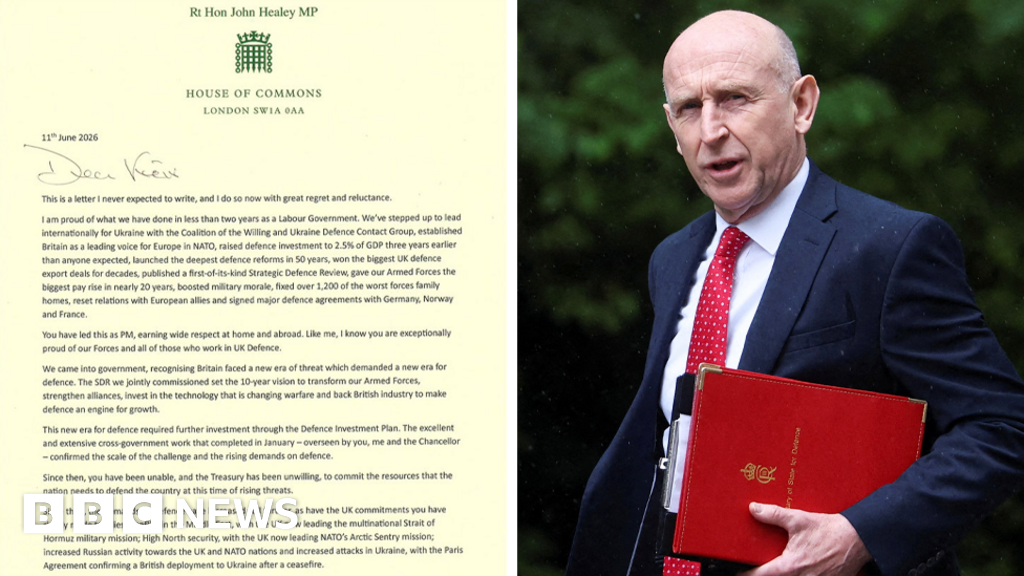
John Healey has resigned as UK defence secretary, saying the government’s defence investment plan fell short and pushed too much funding into later years. In a resignation letter published in full by BBC News, he said the Treasury was not committing enough resources at a time of rising threats.
John Healey has resigned as UK defence secretary, saying the government’s defence investment plan did not go far enough and left too much of the money until later years.
BBC News published Healey’s resignation letter in full on Thursday, June 11, 2026, giving a sharper account of why he quit than the first reports of his departure.
In the letter to Prime Minister Sir Keir Starmer, Healey argued that the settlement on defence spending fell short of what was needed at a time of rising threats.
He said the Treasury had not committed enough resources and warned that the plan could leave the armed forces under avoidable pressure on readiness and procurement.
The resignation
Healey’s departure marks a significant cabinet change in a key security brief. He had served as defence secretary since Labour took office in July 2024.
The resignation was reported unexpectedly, and the details published by BBC News and other outlets show that the dispute was not simply over the overall amount of spending. The main issue was the shape of the funding and when it would arrive.
Healey’s letter makes clear that he believed the government was failing to match the scale of the challenge facing the armed forces.
The timing also matters. The BBC published the letter at 11:55 UTC on June 11, before later coverage expanded on the political and fiscal dispute behind the resignation.
The funding dispute
Reporting by The Guardian said Healey objected that only about £10 billion of a £13.5 billion package was genuinely new money, with too much of the rest pushed into later years.
The same reporting said the settlement would take defence spending to 2.68% of GDP by 2030.
That sits alongside the government’s broader promise, reported by the Associated Press, to raise defence spending to 2.5% of GDP by 2027 and 3% by 2034.
The row centres on the Defence Investment Plan, which had not yet been published when Healey resigned. That leaves the dispute focused on the plan’s design as much as its headline total.
Healey’s criticism was therefore not just that the package was too small. It was that too much of it was deferred, limiting the immediate benefit for military readiness, procurement and the wider defence posture.
Pressure on Starmer and Reeves
The resignation puts new pressure on Prime Minister Keir Starmer and Chancellor Rachel Reeves, with the Treasury now at the centre of the argument.
Reporting says Healey’s complaint was that the settlement did not give defence the immediate backing it needed, even as the government has been promising a longer-term increase in spending.
That creates both a policy problem and a political one. The government now has to explain whether the existing plan is sufficient, or whether Healey’s resignation will force a rethink.
The dispute also highlights the tension between fiscal control and military planning. Healey’s letter suggests he believed the Treasury’s approach delayed too much of the burden onto later years, when the strategic pressures would still be present.
For Starmer, the resignation is awkward because it turns an internal funding debate into a public test of authority. For Reeves, it places the Treasury’s spending assumptions under direct scrutiny from the departing cabinet minister in charge of defence.
What the dispute means
The stakes extend beyond Whitehall. Reporting has linked the disagreement to military readiness, procurement timing, NATO-facing commitments and the government’s credibility on defence spending.
That is why the detail of the funding package matters. The row is not only about how much the UK plans to spend, but about when the money is available and how much of it is genuinely new.
Reporting says Healey warned the plan could damage military readiness and UK security at a time of rising threats. That warning is central to understanding why the resignation is being treated as more than a routine cabinet change.
The Defence Investment Plan was central to the dispute, and the fact that it had not yet been published when he resigned suggests the argument had reached a breaking point before ministers had even put the full proposal into the public domain.
Open questions
The immediate questions are who will replace Healey at the Ministry of Defence and whether the government will alter the Defence Investment Plan.
There is also uncertainty over whether Healey will give a fuller public explanation or appear in Parliament to expand on the reasons for quitting.
Reporting indicates that the episode may not end with the resignation letter. If the government stands by the plan, the row over defence funding is likely to continue. If it changes the numbers or timings, Healey’s departure may be seen as the catalyst for a policy shift.
For now, the resignation has widened a broader argument over how quickly the UK should raise defence spending, how much of it should be genuinely new money and how soon the armed forces should see the benefit.
Revision note
Expanded with full chronology, funding details, political context, and open questions.