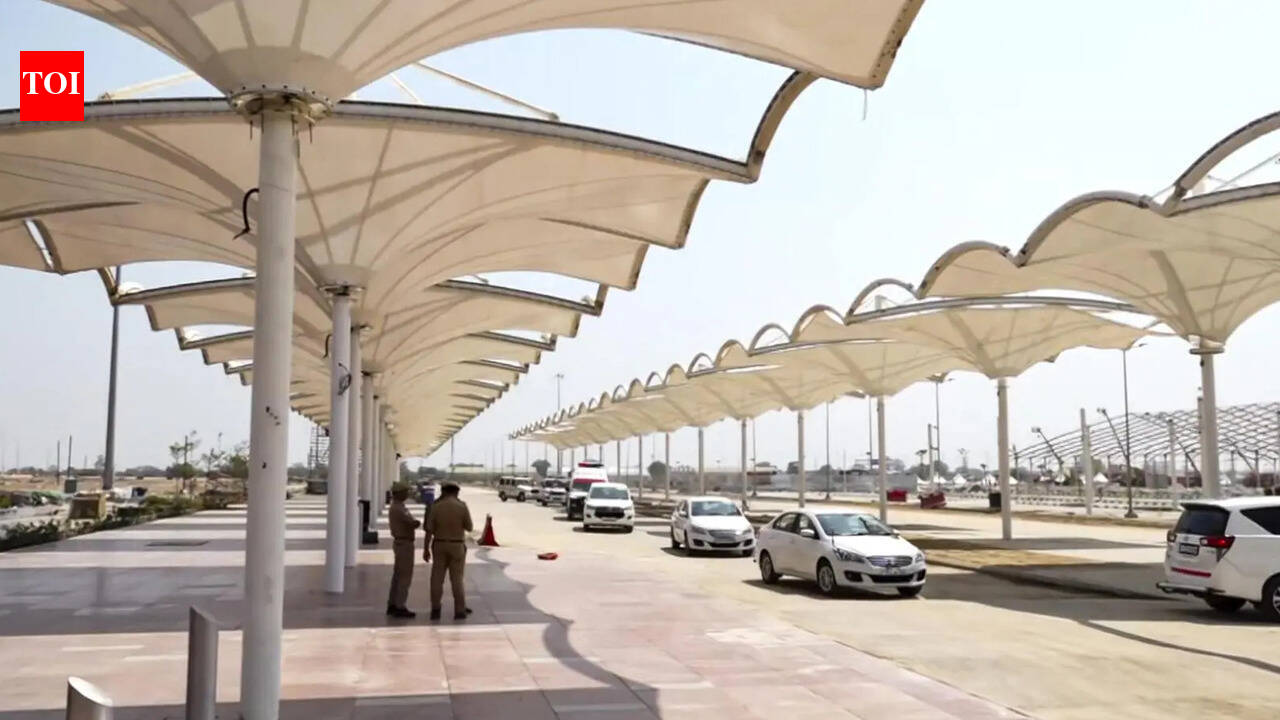
Ahead of Noida International Airport’s June 15 launch, district administration and traffic police have issued a traffic and parking plan for private vehicles, taxis, buses, auto-rickshaws and cargo carriers, while road transport remains the main access option at opening.
Noida International Airport is days away from opening, and district officials are now focused on a practical launch-day question: how travelers, taxis and cargo vehicles will reach the terminal.
District administration and traffic police have issued a detailed traffic and parking plan ahead of the June 15 launch, covering private vehicles, cargo carriers, taxis, buses and auto-rickshaws. The advisory is meant to manage access from Uttar Pradesh, Delhi and neighboring regions as operations begin.
The move matters because the airport is opening before its longer-term surface links are fully in place. Separate reporting earlier this week said passengers would initially depend mainly on cabs and private cars, because metro connectivity is not yet available and the proposed electric bus service had not started at that point.
That makes the first days of operation a test of the temporary road-based setup. Congestion, parking and last-mile transport are now the most immediate public-facing issues for the new airport.
Launch-day access plan
The police advisory adds a layer of direction for the roads around the airport at opening, rather than leaving traffic to self-organize around the terminal.
The plan covers both passenger and freight movement, reflecting the airport's dual role as a commercial gateway for travelers and cargo operators. That means private motorists, taxis, buses and freight carriers will all be part of the same early traffic picture.
While the full route map and parking allocation details have not yet been laid out in the reporting available, the decision to issue a formal plan signals that authorities expect a heavy operational load around the airport approach roads from day one.
Why road transport is central
Noida International Airport, also known as the Jewar airport, is a greenfield airport in Gautam Buddha Nagar district. Its opening has attracted attention not only because it adds airport capacity for Delhi-NCR, but because the wider transport network around it is still developing.
With metro access not yet in service at launch, road travel is the immediate fallback for most passengers. That leaves cabs, private cars and road-based public transport as the main ways to reach the airport when the first flights begin.
The traffic and parking plan is therefore more than an administrative detail. It is the main short-term answer to a basic access problem: how to get large numbers of passengers and vehicles to a new airport before permanent mass-transit links arrive.
Buses as partial relief
There has been some movement on public transport around the airport zone. On June 13, Uttar Pradesh Chief Minister Yogi Adityanath flagged off 45 electric buses and three hydrogen buses for Noida, Greater Noida and Yamuna City.
Those vehicles are intended to improve last-mile connectivity in the wider area. They do not replace metro access, but they are part of the effort to make the airport approach more workable while the longer-term network is still under construction.
That still leaves uncertainty about how much relief they can provide at launch. The available reporting suggests passengers will continue to rely heavily on cabs and private vehicles in the opening phase, with bus service only a partial mitigation.
What travelers should watch next
The next important update will be the full police route map and parking allocation, which should clarify where vehicles will be routed and where they can stop or wait.
Travelers should also watch for any airport operator guidance, since terminal-side instructions can affect drop-offs, pickups and how far passengers may need to walk from parking or designated curb space.
Another open question is whether any temporary shuttle or feeder service is added before or just after opening. For now, the evidence points to a launch centered on road access, with cabs, private cars and the new bus fleet doing most of the work.
For passengers and cargo operators, the immediate test is simple: whether the temporary road plan can absorb launch-day demand without major delays.
,Revision note
Initial automated publication.