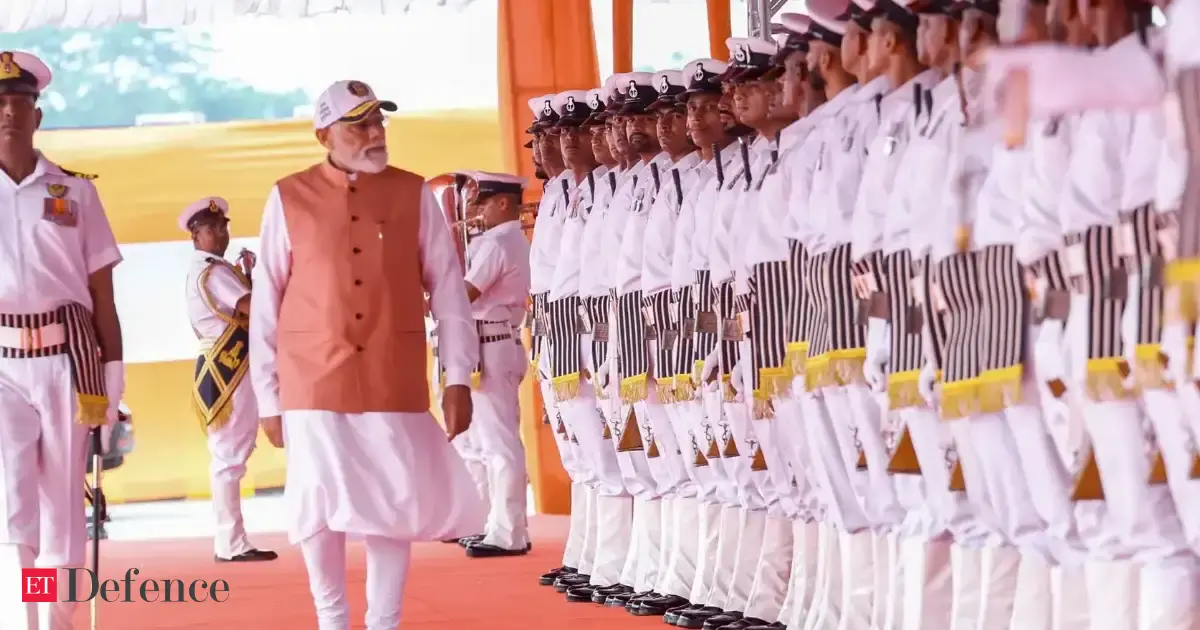
Prime Minister Narendra Modi used the commissioning of three indigenous naval ships in Kolkata to argue that India should become a defence manufacturer, not just a buyer. He said domestic defence production has grown from about Rs 700 crore to about Rs 40,000 crore and tied maritime strength to economic growth, security and jobs.
Prime Minister Narendra Modi on Sunday used the commissioning of three indigenous naval ships in Kolkata to press India’s case for becoming a defence producer, not just a customer.
The event brought the Indian Navy’s INS Dunagiri, INS Sanshodhak and INS Agray into service in a ceremony at Garden Reach Shipbuilders & Engineers, a major shipbuilding site in the city. Modi linked the commissioning to a broader argument about India’s maritime strength, industrial capacity and strategic influence.
He said India should not remain a “mere buyer” in defence and should instead build up its own manufacturing base. In remarks reported from the event, he also said domestic defence production had increased from about Rs 700 crore to about Rs 40,000 crore. That figure should be treated as a claim from his speech unless independently verified.
Maritime power and national goals
Modi tied the sea to development, security and prosperity, saying strong maritime capability affects both economic growth and strategic influence. He also framed the maritime sector as a source of jobs and industrial activity, placing shipbuilding within the government’s wider self-reliance push in defence.
The message fits the broader Make in India and Atmanirbhar Bharat agenda, under which New Delhi has tried to expand domestic production of military equipment and reduce dependence on foreign suppliers.
The ships commissioned in Kolkata
The three ships were commissioned during the same visit in Kolkata.
One report identified the vessels as the frigate INS Dunagiri, the survey vessel INS Sanshodhak and the anti-submarine warfare shallow-water craft INS Agray. Another report described the event as the commissioning of three indigenous frontline naval ships.
Kolkata remains a significant centre for Indian naval shipbuilding through GRSE, which has long been part of the country’s defence-industrial base.
What it means
The commissioning offered Modi a platform to argue that India is not just a market for imported military equipment but an emerging manufacturing hub.
The stakes are both industrial and strategic: domestic defence production can support jobs, expand shipbuilding capacity and strengthen naval readiness as India looks to secure its maritime interests.
Further official detail on the ships’ capabilities and the commissioning significance may follow from the Navy or Defence Ministry. Reporting may also test the production-growth figure against official defence-industry data.
Revision note
Initial automated publication.