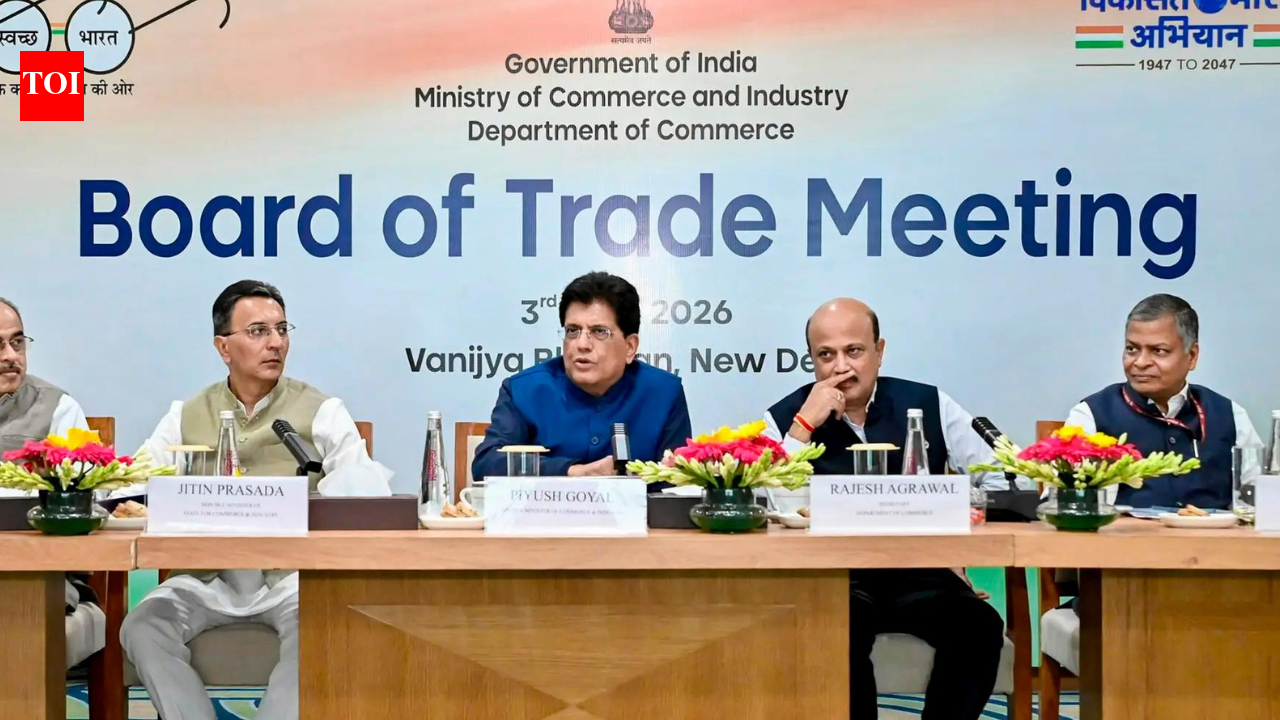
India has set a $1 trillion export target for the current fiscal year, with Commerce Minister Piyush Goyal citing stronger merchandise and services growth, new trade agreements and a seven-point export action plan after a Board of Trade meeting in New Delhi.
Export target
India has set a $1 trillion export target for the current fiscal year, Commerce and Industry Minister Piyush Goyal said on Friday after a Board of Trade meeting in New Delhi.
Goyal said the goal builds on a year in which India exported goods and services worth $863 billion, including about $442 billion in merchandise exports and $421 billion in services exports. To reach the new target, he said merchandise exports would need to rise to about $530 billion and services exports to about $470 billion.
He framed the target as an extension of the government’s broader push to expand export capacity and deepen trade links, rather than as a one-off announcement. The meeting brought together officials and state representatives as the ministry pressed for a wider policy and infrastructure response.
Growth assumptions
Goyal said the government expects merchandise exports to grow 16% to 17% in the current fiscal year and services exports 10% to 11%. He added that merchandise exports and services exports grew 15% and 11%, respectively, in the April-June quarter.
The minister’s comments suggest the target rests on sustained momentum early in the year, but the numbers also show how much stronger the rest of the fiscal year would need to be to hit the $1 trillion mark.
The reporting did not indicate that the target was tied to a new formal budget outlay. Instead, it was presented as a ministerial and policy target backed by trade promotion, market access measures and state-level coordination.
Trade policy push
Goyal linked the export goal to recent free trade agreements that he said have opened markets across 38 developed countries. He also said the India-UK free trade agreement will become operational on July 15, giving 99% of Indian goods zero-duty access to the British market.
That timing makes the UK deal one of the clearest near-term policy supports for the export agenda. The ministry is also leaning on broader market-access efforts as it looks for faster growth in both manufactured goods and services.
Seven-point agenda
The minister outlined a seven-point export action agenda that includes giving exports higher priority in state and industry bodies, notifying labor rules, fully funding testing facilities and supporting the Export Promotion Mission.
He also called for more use of the Directorate General of Trade Remedies against dumping, greater participation in global exhibitions, alignment of state industrial policies with the Centre and support for import-substitution industries.
The agenda points show that the ministry is treating export growth as an ecosystem problem, not just a demand problem. Testing capacity, industrial policy and trade-remedy enforcement were all presented as part of the same push.
States and sectors
The Board of Trade meeting also surfaced state-level requests for stronger export infrastructure support. A separate report said Madhya Pradesh sought a boost from the Centre, underscoring that states want a bigger role in the export drive.
Goyal also pointed to defence exports as evidence that India can widen its export base. He said India exported record defence equipment worth Rs 38,400 crore last year to 100 countries.
The target leaves several open questions, including how quickly the ministry will publish the full action plan, whether additional implementation details will follow and whether export growth can stay on track through the rest of the fiscal year. The latest reporting also leaves unclear whether the goal was formally adopted by the full Board of Trade or presented as a ministerial target at the meeting.
For now, the policy signal is clear: the government wants exports to rise sharply in a year when both merchandise and services are expected to do more of the heavy lifting.
Revision note
Initial automated publication.