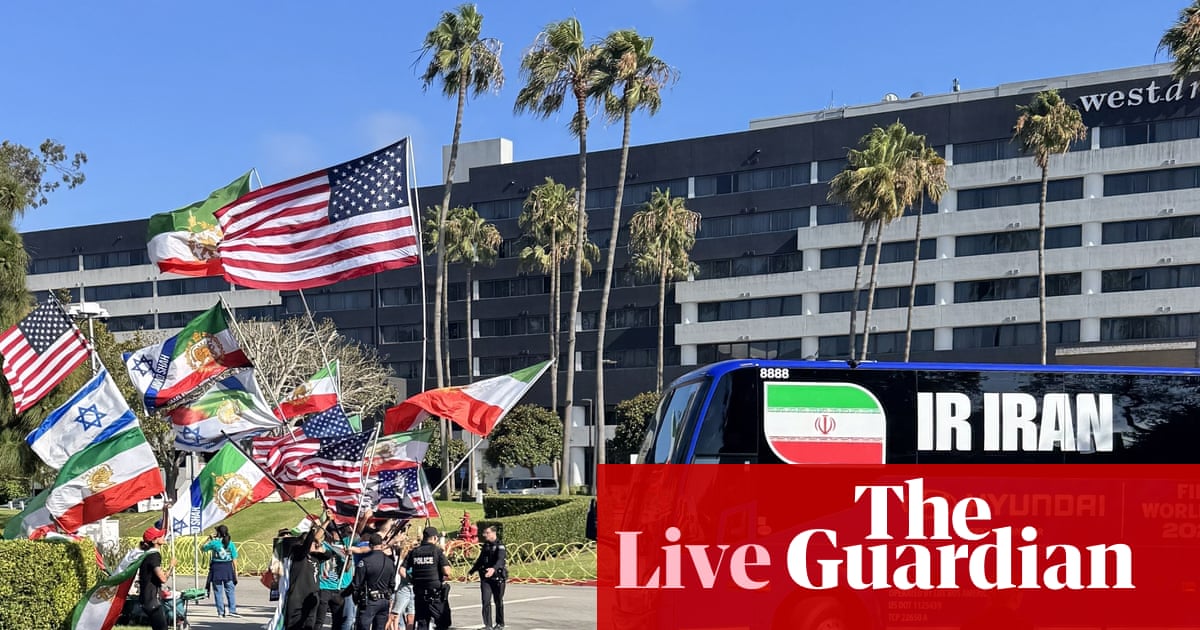
Iran’s World Cup squad arrived in Los Angeles after visa complications and a move of its training base to Mexico, then played New Zealand in its opener under the shadow of a newly announced U.S.-Iran peace framework. Mehdi Taremi said the political tension had undermined the joy of the tournament, while coach Amir Ghalenoei said the team would stay focused on football; the match finished 2-2.
Iran’s World Cup squad arrived in Los Angeles ahead of a politically charged opener against New Zealand, after a build-up shaped by visa complications, a late change of training base and a newly reported U.S.-Iran peace framework.
The team’s trip to the United States was unsettled before it began. Reporting from the days before kickoff said members of the delegation faced visa problems, and Iran shifted its training base to Mexico after the disruptions. That left the squad preparing for a World Cup match away from its intended base and under unusual scrutiny.
The backdrop grew more charged when a framework peace deal between the United States and Iran was reported shortly before the opener. That did not remove the tension around Iran’s presence in Los Angeles. Instead, it sharpened the contrast between the sporting occasion and the wider politics surrounding it.
Mehdi Taremi, one of Iran’s leading players, said the tension had undermined the joy of the tournament. Coach Amir Ghalenoei struck a more controlled tone, saying the team would stay focused on football despite the pressure around them.
Arrival and preparation
Iran arrived in Los Angeles on June 15, with the squad already having navigated travel disruption that complicated its pre-match routine. The reported visa issues affected the delegation before it reached the city, and the team’s move to a training base in Mexico underscored how unsettled the build-up had become.
The sequence mattered because World Cup preparation is usually built around stability. Instead, Iran entered its opener having dealt with questions over who could travel, where the team could train and how much normal routine it could preserve before the match.
Reporting also indicated that several members of the Iranian party were denied entry, though the latest coverage did not fully specify every affected individual. Even without full detail on each case, the broader picture was clear: the team’s arrival in the U.S. was delayed, complicated and politically sensitive.
Political backdrop
The match carried significance far beyond football because of the U.S.-Iran relationship and the size of the Iranian diaspora in the United States. The peace-framework announcement just before kickoff added a new layer to that backdrop, but it did not settle the debate over Iran’s presence at the tournament.
Outside the stadium, Iranian-American protesters gathered. Inside, support for Iran was also strong. That split reflected the wider divide within the diaspora, with some treating the game as a political flashpoint and others as a moment to back the national team.
Iran had previously sought to move its group-stage matches away from the United States, but that request was not granted. The Los Angeles opener therefore became not just an opening fixture, but a test of how the team would handle security concerns, political attention and the pressure that followed it.
The Match
On the field, Iran drew 2-2 with New Zealand in Los Angeles. New Zealand’s Elijah Just scored both of his side’s goals, while Ramin Rezaeian and Mohammad Mohebbi scored for Iran.
Mohebbi’s equalizer arrived in the 64th minute and secured a point for Iran in a game that had been framed by events off the pitch as much as by the football itself. The result gave Iran an immediate sporting foothold, even as the political context remained unavoidable.
For Iran, the immediate challenge now is to keep the campaign moving while the surrounding scrutiny continues. The remaining group matches are likely to keep security, access and protest concerns in view, and officials could still face pressure to comment further on fan entry and delegation protection.
The bigger picture is that Iran’s World Cup story is being shaped by two parallel developments: the team’s performance on the pitch and the diplomatic atmosphere around its presence in the U.S. The opener showed that both will matter in the weeks ahead.
What Comes Next
The next questions are whether the political climate affects Iran’s remaining matches in Seattle or elsewhere, and whether FIFA or U.S. officials issue any additional statements on access, security or fan entry.
For now, the team has already had to absorb a difficult arrival, a reshaped training plan and a charged opener. Taremi’s verdict captured the mood: the football is still there, but the joy has been reduced by everything surrounding it.
Revision note
Expanded with full chronology, political context, match detail and forward look.