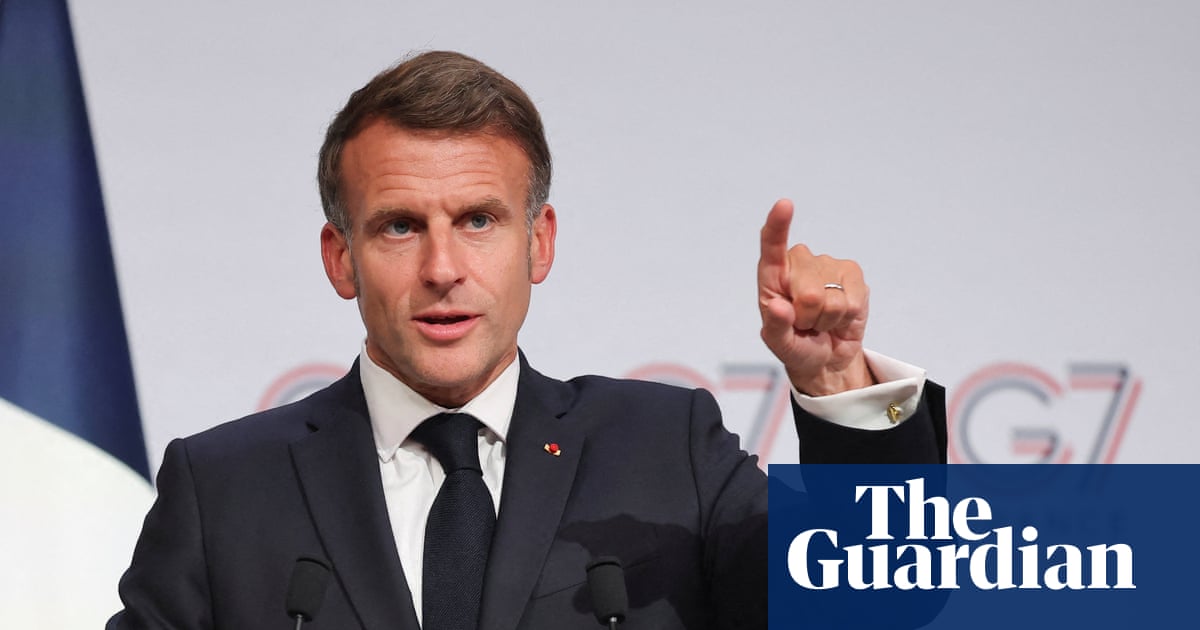
Emmanuel Macron said the G7 has moved to a shared position on Ukraine, with the United States aligned alongside allies as leaders discuss stronger sanctions on Russia, air-defense support and licensed weapons production in Ukraine.
Macron signals a G7 shift on Ukraine
Emmanuel Macron said the Group of Seven has moved into a shared position on Ukraine, including the United States, as leaders gathered at the G7 summit in Évian-les-Bains, France.
Macron described the change as a re-synchronisation of G7 positions. According to the reporting, he said the group now recognizes Ukraine’s territorial integrity and has a common commitment on the issue.
The comments matter because the G7 has often struggled to present a fully unified line on Ukraine, especially when the United States has appeared less aligned with European governments. This summit coverage suggests a more coordinated front, even if some details of the package still need to be formally confirmed.
What the summit is discussing
Reporting on June 17 said leaders were weighing stronger sanctions on Russia, particularly in the energy sector. That fits with the broader Western effort to pressure Moscow’s revenues while keeping military and economic support flowing to Kyiv.
The summit discussion also includes support for licensed production of long-range missiles and air-defense systems inside Ukraine. If formally adopted, that would go beyond simple weapons deliveries and deepen Ukraine’s domestic defense industry.
AP reported earlier that G7 leaders pledged stronger support for Ukraine’s air defenses, energy infrastructure and sanctions on Moscow. The report also said leaders were discussing possible domestic production of Western weaponry in Ukraine.
Later coverage added Macron’s explicit statement that the G7, including the U.S., had aligned around a shared commitment. That makes the summit’s Ukraine messaging more than a routine reaffirmation and suggests a notable shift in tone.
Zelenskyy’s parallel message
Volodymyr Zelenskyy separately said G7 leaders agreed on more help for Ukraine’s defense and energy resilience. His remarks match the summit’s focus on two of Ukraine’s most urgent needs: air defense and protection for power infrastructure.
Ukraine has repeatedly sought additional missiles and air-defense systems as Russian attacks continue to target energy facilities and other critical sites. Support for local production would also help reduce dependence on imported systems over time.
The reporting does not yet identify which countries or companies would be involved in any licensed production arrangement, or where the manufacturing would take place. It also does not confirm whether that plan has been finalized or is still under discussion.
Why the U.S. alignment matters
The most consequential part of the reporting is Macron’s claim that the United States is now part of the same shared G7 position on Ukraine. That would mark a clearer alignment between Washington and European allies at a moment when unity on Ukraine remains strategically important.
A more united G7 line could strengthen allied leverage on sanctions, deterrence and any future negotiations involving Russia. It could also signal to Moscow that support for Ukraine remains broad and politically durable among the leading Western economies.
The production plan is important for a second reason: it could help Ukraine build more long-term military capacity at home. Licensed manufacturing of missiles and air-defense systems would not only support the war effort now, but could also leave Ukraine with a stronger defense-industrial base later.
What remains unresolved
The exact wording of any final G7 communiqué has not been confirmed in the reporting reviewed here. That leaves open how much of the summit discussion is already locked in and how much still depends on final leaders’ language.
It is also unclear how specific any new sanctions package will be beyond broader pressure on Russia’s energy sector. The reporting reviewed here does not identify the exact measures, timing or enforcement mechanisms.
Further clarity may come from a final summit statement, public comments from U.S. officials, or additional remarks from Zelenskyy and other leaders. For now, the clearest confirmed development is Macron’s claim that the G7 has shifted toward a shared line on Ukraine, with more sanctions and defense-industrial support under discussion.
Revision note
Initial automated publication.