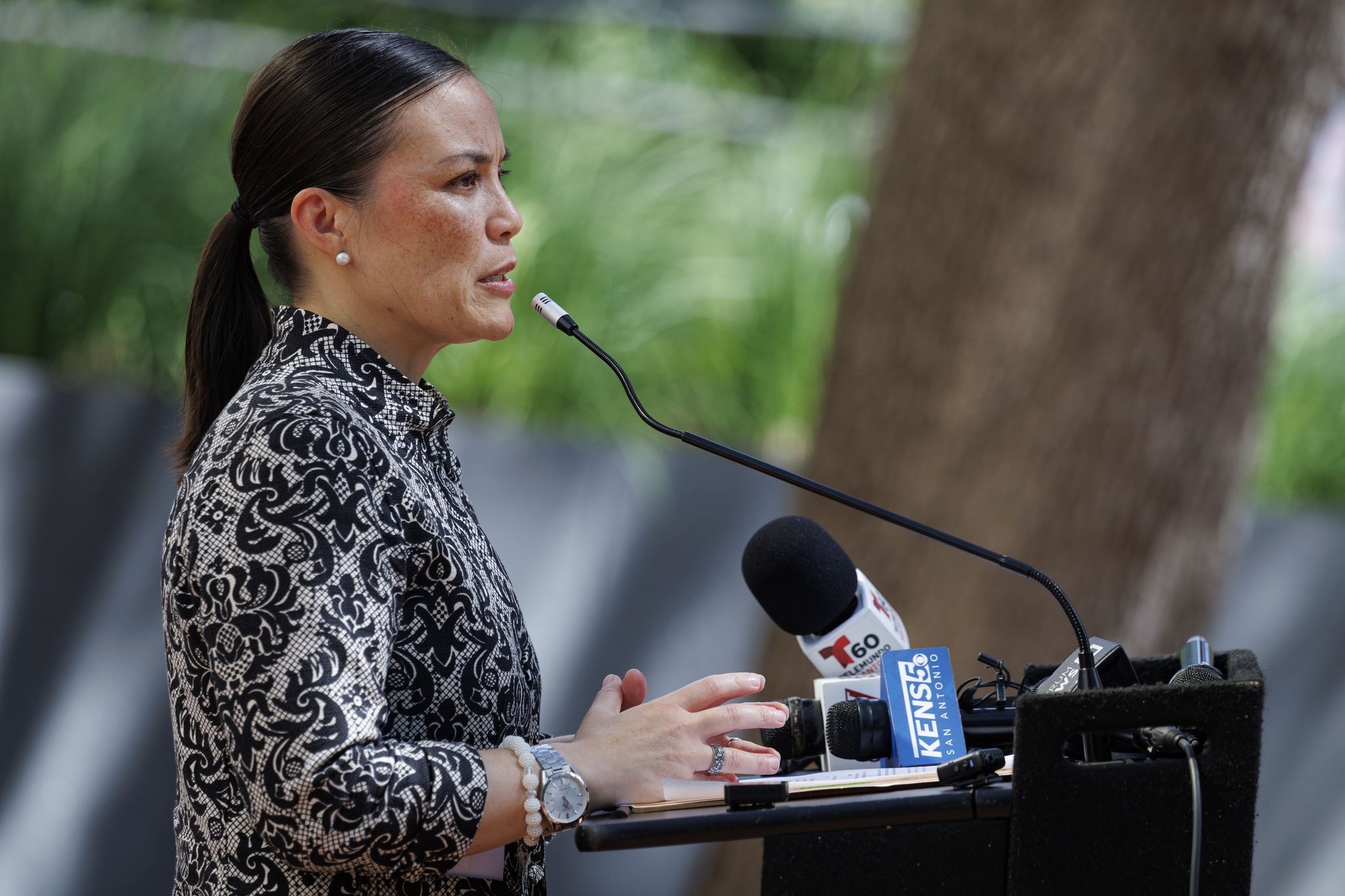
Mayor Gina Ortiz Jones's voting commission has recommended turning San Antonio's Communications and Engagement department into a new Office of Civic Participation to expand year-round voter outreach, registration and education. The proposal still needs approval from City Manager Erik Walsh or the City Council before it can move forward.
Mayor Gina Ortiz Jones is trying to turn her turnout push into a lasting City Hall structure.
A voting commission she convened released a report July 9 recommending that San Antonio create a new Office of Civic Participation by restructuring the city’s Communications and Engagement department.
The proposal would make voter registration, voter education, turnout outreach and public engagement a year-round city function instead of a task handled mainly around elections.
The report is the clearest sign yet that Jones wants the city to treat voter participation as a standing civic responsibility, not just a campaign-season project.
But the recommendation is not automatic. It would still need approval from City Manager Erik Walsh or a City Council vote directing him to act.
What the commission wants
At the center of the report is a shift in philosophy: City Hall should move from a largely reactive communications model to sustained civic outreach.
Under the proposal, the new office would focus on nonpartisan voter registration, voter education, turnout outreach and broader public engagement throughout the year.
The commission said that approach could help reach renters, disabled voters, students and people who work evening or overnight shifts, groups it says are harder to reach through traditional election outreach.
The report also recommends expanding polling sites and creating a central “super center” voting location.
It further calls for lower-cost steps, including annual civic goals and a Civic Engagement Nonprofit Coordination Roundtable.
How Jones got here
Jones created the voting task force in May 2026 and asked it to return quickly with ideas for improving turnout.
The group’s work culminated in the July 9 report recommending a more permanent civic-participation structure inside City Hall.
That recommendation fits Jones’s broader turnout strategy. San Antonio already approved moving city elections from May to November in odd-numbered years, starting in 2029, after turnout was repeatedly cited as a problem.
The city’s May 2025 mayoral election drew just above 9% turnout, underscoring how little of the electorate was showing up in local contests.
What still has to happen
The commission is technically a task force because City Council never voted to approve its creation.
That means the report does not itself create a new office or budget. City Manager Erik Walsh could choose to adopt the restructuring administratively, or the council could direct him to do so.
Council could also decide to keep the task force alive as an advisory group instead of letting it disappear after the report.
Jones has said she wants at least some of the strategies in place for the November election cycle, which suggests staff may try to move the cheaper recommendations first.
The likely near-term split is between actions that can be folded into existing city operations and changes that would require a formal staffing or budget decision.
Why it matters
If adopted, the proposal could change how San Antonio handles voter outreach, registration and civic engagement year-round.
It would also require the city to decide whether civic participation is a communications function, a management priority or a separate office with its own mandate.
For voters, the practical question is whether the city can make any changes quickly enough to matter before the next election cycle.
For City Hall, the proposal creates a test of whether Jones can convert a turnout campaign into a permanent administrative structure.
The report provides the blueprint. The remaining question is whether Walsh or the council will act, and how fast any change can be in place.
,Revision note
Initial automated publication.