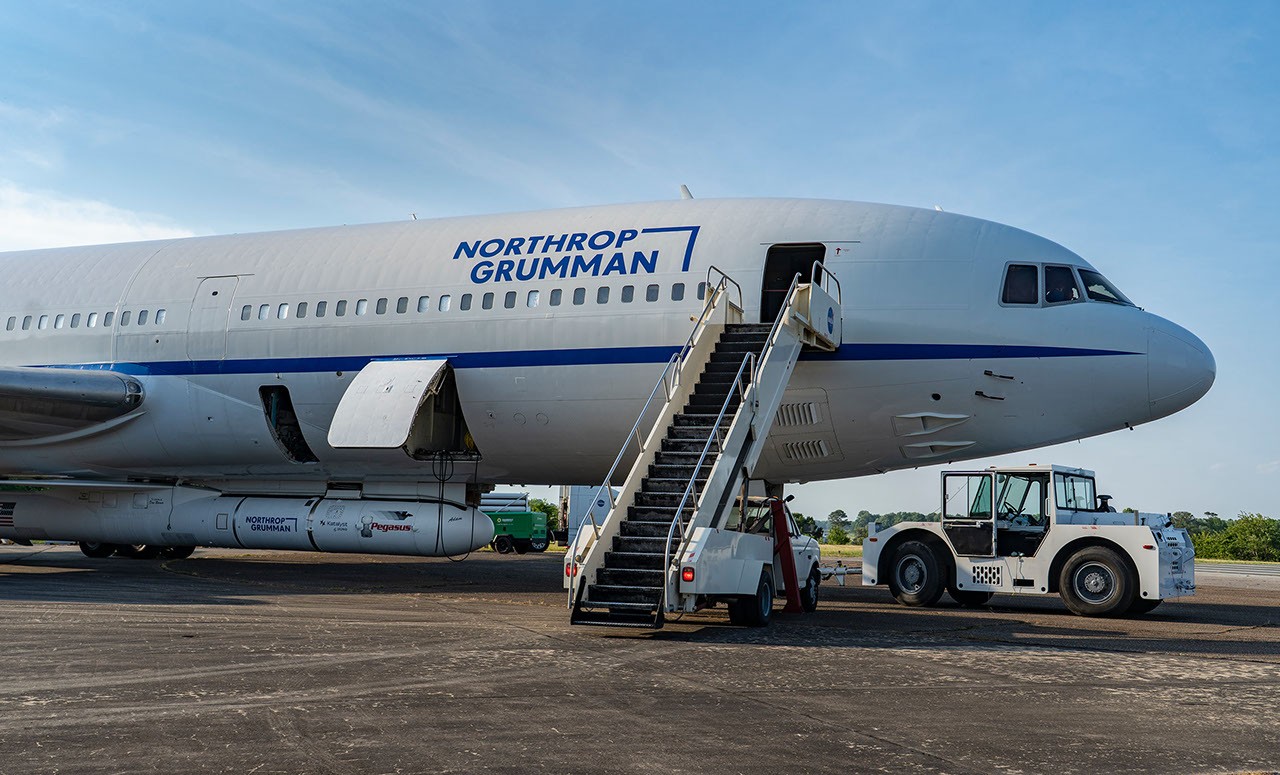
NASA and Katalyst Space Technologies launched the LINK spacecraft on July 3 to attempt the first orbital boost of the Neil Gehrels Swift Observatory after weather and software delays.
NASA and Katalyst Space Technologies launched the LINK spacecraft on July 3 from Kwajalein Atoll in the Marshall Islands, beginning the first attempt to raise the orbit of the Neil Gehrels Swift Observatory.
The mission is meant to test whether a private spacecraft can rendezvous with an uncrewed NASA satellite, grapple it and help lift it to a safer altitude. NASA says the work could also show a future way to service spacecraft that were never designed to be repaired in orbit.
Launch after delays
LINK reached orbit on Northrop Grumman’s Pegasus XL rocket, which was dropped from the L-1011 Stargazer aircraft. NASA said the launch lifted off from the Marshall Islands site after earlier delays pushed the mission back.
The agency first delayed the attempt because of weather, then reset the launch date after a software problem affected Pegasus navigation. NASA updated the target to July 3 and then confirmed the liftoff within hours.
NASA said the spacecraft must first check in after orbit insertion and confirm that its solar panels and power systems are working before any rendezvous sequence begins. Only after that will controllers move toward close approach and grappling operations.
Why Swift needs help
Swift launched in 2004 and has spent more than two decades observing gamma-ray bursts and other high-energy cosmic events. NASA says the observatory still has scientific value, but its orbit has been decaying faster than expected.
The agency says recent solar activity increased atmospheric drag, which has been pulling the telescope lower over time. Swift does not have propulsion of its own to raise its orbit, and NASA says it was not designed to be serviced.
AP reported that Swift is currently about 224 miles, or 360 kilometers, above Earth. NASA’s mission page says the goal is to return it toward its original altitude of about 373 miles, or 600 kilometers.
What the mission will do
NASA contracted Katalyst Space Technologies in September 2025 to carry out the boost mission. The agency has said the project costs $30 million and is intended as a demonstration of future satellite-servicing capability.
If LINK completes the planned sequence, it will approach Swift, assess grapple points and then attempt to capture the observatory. The orbit raise would take place gradually over several months rather than in a single maneuver.
NASA has framed the mission as both a rescue attempt and a technology test. A successful reboost would show that a commercial spacecraft can reach and help preserve a government satellite that was not built for this kind of intervention.
Stakes for Swift and beyond
The stakes are high because Swift remains useful for high-energy astronomy. NASA says the observatory can still observe gamma-ray bursts and other cosmic events, and losing it to atmospheric reentry would erase a working scientific asset.
A successful mission could extend Swift’s life and potentially return it to science operations by September, according to AP and NASA coverage. It would also create a precedent for future satellite rescue and servicing missions.
The launch itself is only the first step. Mission controllers now have to verify that LINK deployed correctly, establish contact and begin the close-approach phase with Swift.
NASA says it will continue posting updates on the mission blog as the spacecraft moves through orbit checkout and rendezvous preparations. The agency has identified the coming days as critical for determining whether the first private orbital rescue attempt for a NASA telescope can continue as planned.
Revision note
Initial automated publication with expanded launch, context, and next-step coverage.