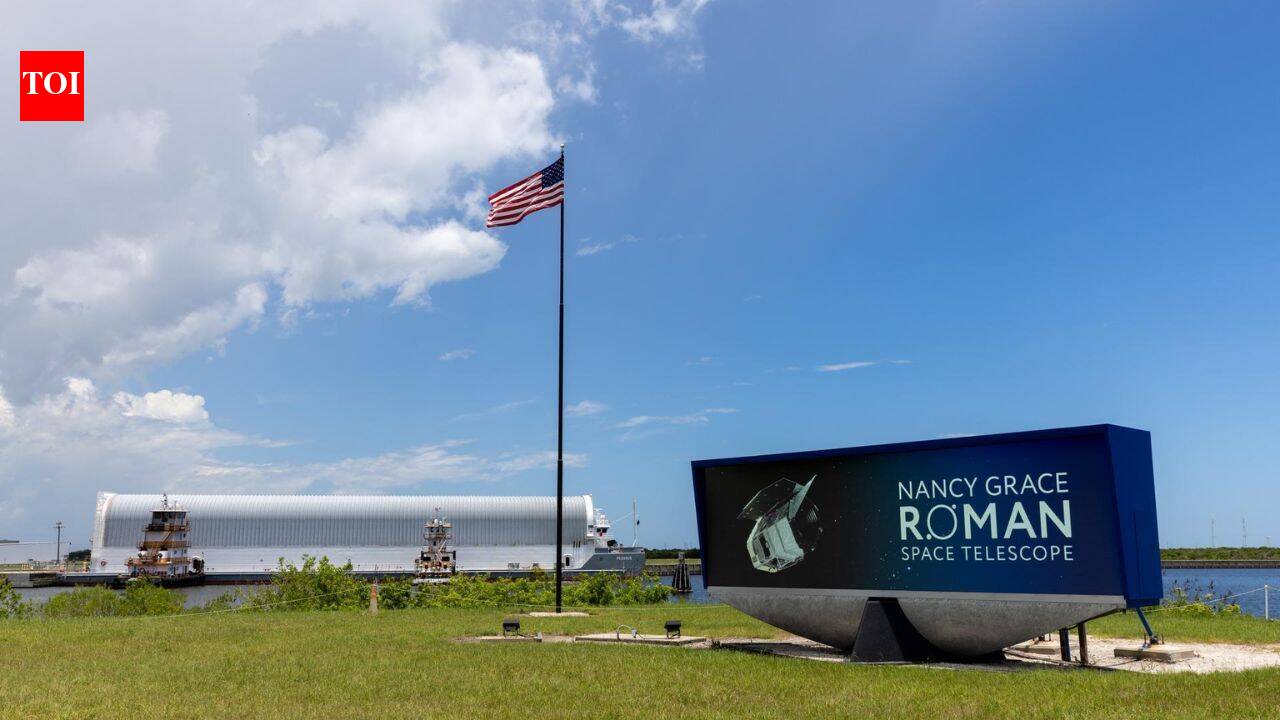
NASA’s Nancy Grace Roman Space Telescope has reached Kennedy Space Center in Florida for final launch preparations after a final mirror inspection and shipment from Maryland. Recent reporting says the mission is still targeting a possible August 30, 2026 launch aboard a SpaceX Falcon Heavy.
NASA’s Nancy Grace Roman Space Telescope has arrived at Kennedy Space Center in Florida for final launch preparations, marking a major step toward the observatory’s first trip to space.
Reporting says the telescope reached Florida on June 21, 2026, after traveling from Maryland. The final leg was completed aboard NASA’s Pegasus barge, the large transport vessel used to move oversized spacecraft hardware.
The arrival shifts Roman from testing and shipment into the final ground phase before launch. Teams at Kennedy are now expected to spend the coming weeks on processing work, checks and preparations ahead of liftoff.
Final inspection and shipment
Roman’s move to Florida follows a final inspection of its primary mirror, which NASA completed before the telescope left Maryland. That mirror check was one of the last major hardware milestones before the mission entered launch-site processing.
Space.com reported earlier this month that the mirror passed its final look before shipment. The report said the telescope was being prepared to ship to Florida, where launch preparations would continue.
That sequence puts the observatory into the last stretch of prelaunch work after years of development and testing. NASA has not said that Roman is fully ready to fly, only that the spacecraft has reached the next stage of its launch campaign.
Launch target and rocket
Recent reporting has described the launch as possible as early as August 30, 2026. That date remains a target rather than a firm commitment, and the exact schedule could still change as NASA finishes the remaining launch processing.
Roman is expected to lift off on a SpaceX Falcon Heavy from Kennedy Space Center. NASA awarded the mission’s launch contract to SpaceX in 2022, tying the observatory to one of the agency’s most powerful rockets.
The spacecraft’s arrival in Florida makes the late-summer launch window more plausible, but the mission still has to clear standard integration and readiness steps before NASA can lock in a flight date.
Why Roman matters
Roman is one of NASA’s flagship astrophysics missions. The wide-field infrared telescope is designed to search for exoplanets and to study dark energy, the universe’s expansion and the large-scale structure of the cosmos.
The mission was formerly known as WFIRST and is named for NASA astronomer Nancy Grace Roman, often described as the agency’s first chief astronomer. Its launch would give researchers a new observatory capable of surveying large areas of the sky with unusual speed and sensitivity.
That scientific promise is part of why the mission’s prelaunch milestones draw close attention. Each completed step brings NASA closer to putting a long-planned flagship observatory into orbit.
What happens next
The immediate next phase is straightforward: final launch processing at Kennedy Space Center. NASA teams will continue verifying the spacecraft, preparing it for integration and watching for any issues that could affect the schedule.
The main question now is whether the August 30 launch target will hold. If the remaining work goes smoothly, Roman could stay on track for a late-summer liftoff. If not, NASA may revise the date again.
For now, the telescope’s arrival in Florida is the clearest sign yet that Roman has entered its final prelaunch stretch.
Revision note
Expanded into a fuller launch-prep report with chronology, mission background, launch target, and next steps.