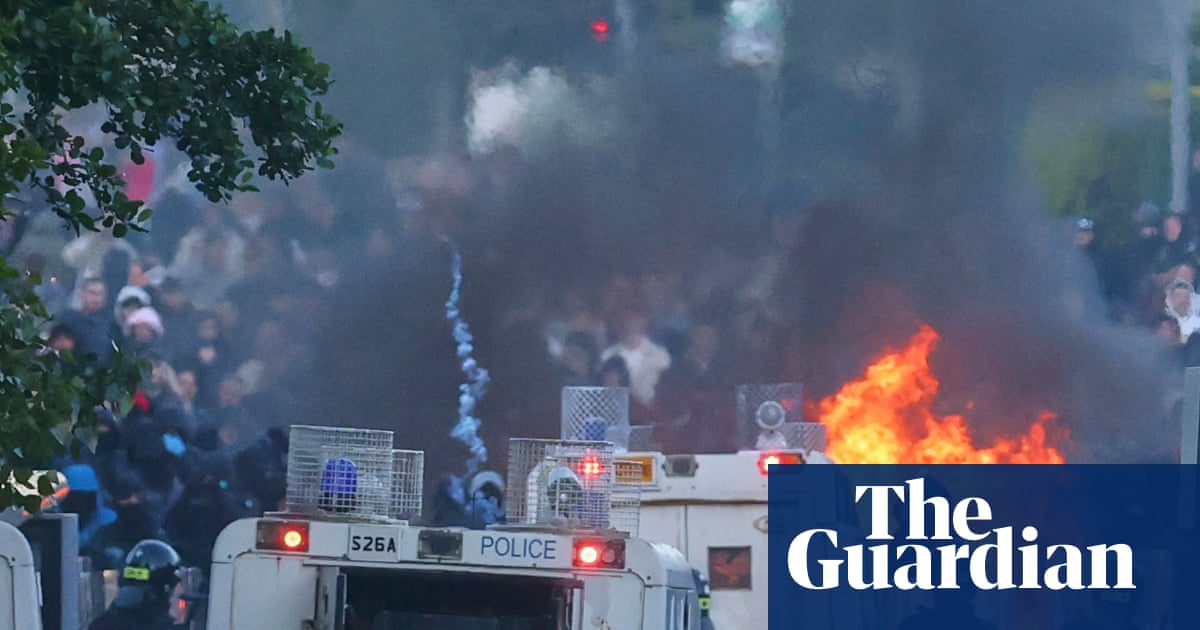
Hilary Benn condemned a second night of violence in Belfast as racist thuggery after 12 police officers were injured and 16 people arrested. The unrest followed a knife attack in north Belfast and has prompted additional police support and UK-Irish discussions on cross-border enforcement.
Hilary Benn has condemned a second night of unrest in Belfast as “racist thuggery” after 12 police officers were injured and 16 people were arrested.
The Northern Ireland secretary said the violence was leaving people from minority ethnic backgrounds living in “terror and fear”. The unrest followed an earlier knife attack in north Belfast that had already triggered anti-immigration protests and broader disorder.
Reporting from Belfast said crowds were stopped near Sandyknowes and the Antrim Road as police faced petrol bombs, bricks, paving stones and other missiles. AP has also reported that the unrest was racially motivated and tied to wider anti-migrant violence in Belfast and surrounding areas.
The violence
The latest disorder came after the earlier stabbing in north Belfast became the flashpoint for protests and then a second night of violence. The sequence has turned a criminal case into a wider public-order crisis, with police dealing with both immediate unrest and the fallout from arrests.
The confirmed injury toll and arrests underline the scale of the response needed on the ground. Police have not only been trying to disperse crowds but also to protect nearby communities and contain attacks on officers.
The coverage available so far places the violence in a wider pattern of intimidation directed at minority ethnic residents and people viewed as migrants. That framing is central to the official response now emerging from Belfast, London and Dublin.
Official response
Benn said the Police Service of Northern Ireland would receive support from Police Scotland, including dog teams, to help with public-order policing. That extra support reflects the pressure on the PSNI after repeated nights of disorder.
He also said the violence was creating fear among minority communities, sharpening the political and policing stakes around the unrest. His comments amount to one of the strongest public condemnations so far from Westminster.
The Irish Department of Justice said Irish and Northern Ireland officials discussed stronger co-operation and enforcement to prevent abuse of the common travel area. That puts the border and travel arrangements between the UK and Ireland directly into the response to the unrest.
The talks suggest the reaction is no longer limited to the immediate policing of riots in Belfast. Authorities are also now looking at whether cross-border movement or enforcement gaps need tighter handling.
What happens next
Police are likely to continue reinforcing public-order operations while processing the arrests from the second night of violence. Further updates could also clarify the extent of damage and whether any more people were injured.
Officials in Belfast, London and Dublin are expected to keep talking about the common travel area and possible enforcement steps. The key question is whether the unrest stays contained or spreads to other areas.
There is also still uncertainty over how far the authorities will go in tightening cooperation in response to the disorder. For now, the immediate focus remains on restoring order and protecting communities that say they are being targeted by the violence.
Revision note
Initial automated publication with expanded chronology and official response.