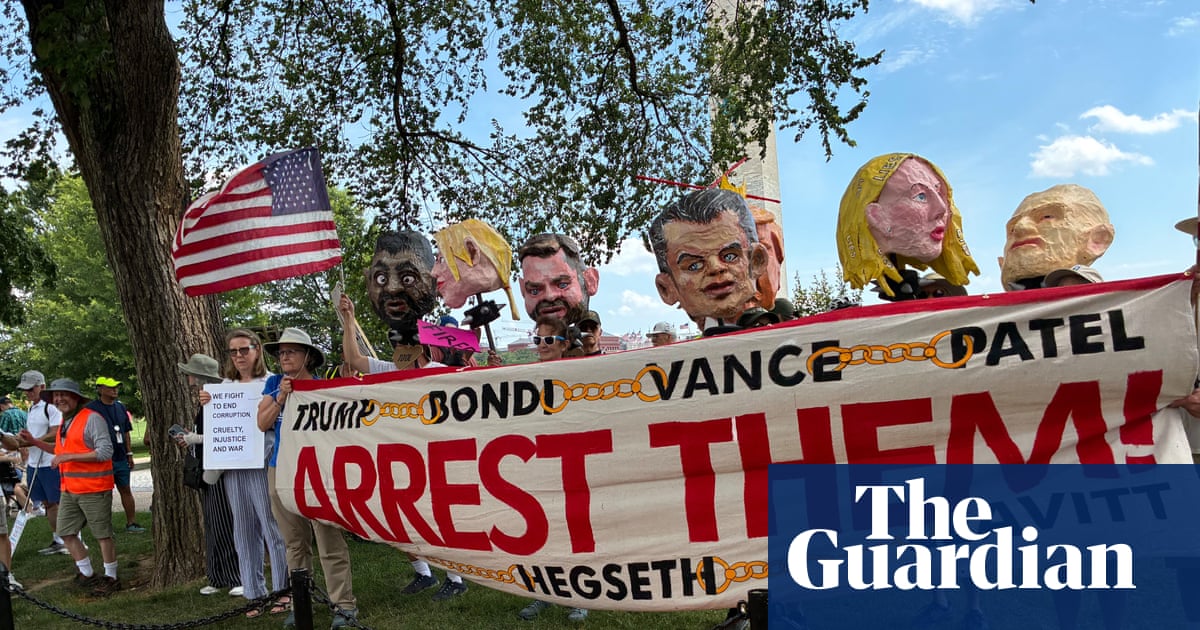
Protesters gathered in Washington as President Donald Trump hosted a UFC event on the White House South Lawn on his 80th birthday. Reporting says an emergency lawsuit to block the card was rejected, while supporters and critics staged competing demonstrations around the spectacle.
Protesters gather as White House hosts UFC card
Protesters gathered in Washington on Sunday as President Donald Trump hosted a UFC event on the White House South Lawn, turning his 80th birthday into a rare and politically charged sports spectacle.
The event drew immediate criticism from demonstrators who said it “reeks of corruption” and questioned whether a commercial fight card belonged on federal property. Reporting described the gathering as a mix of politics, sport and symbolism, with Trump supporters and opponents both converging on the city.
The card went ahead after an emergency lawsuit seeking to block it was rejected. That left the event free to proceed on the South Lawn, where the White House was turned into the backdrop for a fight promotion.
A dispute over federal ground and political symbolism
The central complaint from critics was not just the event itself, but the setting. Hosting a UFC card at the White House intensified questions about the use of a public federal venue for a commercial product, especially one tied so closely to the president’s public image.
The timing added another layer. Because the event coincided with Trump’s 80th birthday, supporters treated it as a celebration, while opponents saw it as an example of how politics, business and spectacle were being blended on the grounds of the executive mansion.
Reporting framed the fight night as part of a broader political moment rather than a standalone sports event. For supporters, it was a large-scale show in Washington. For critics, it raised concerns about access, favoritism and the appearance of impropriety.
Protests, counterprotests and crowds in Washington
Accounts from the day described protesters gathering in the capital to denounce the White House card, while supporters also showed up around Washington for the event. The result was a split public scene outside and around the venue, with competing demonstrations marking the day.
One report said an alternate anti-violence gathering was organized nearby, adding to the range of public responses to the event. Another account described thousands of people in the city for the UFC card, reflecting the scale of attention surrounding the White House setting.
The event itself was described as a seven-fight card. Even before the first bout was underway, it had become a political flashpoint because of where it was held and the questions it raised about the line between government space and private promotion.
Legal challenge fell short
The emergency lawsuit aimed at stopping the event did not succeed, according to the reporting. That legal defeat removed the immediate obstacle to the card and allowed the UFC program to proceed as planned on White House grounds.
The rejected challenge underscores how quickly the dispute moved from protest to the courts and then back into the public square. With the event already underway, the remaining questions shifted from whether it could be stopped to what fallout it might produce afterward.
What comes next
The immediate next phase is likely to center on statements, estimates and scrutiny. Reporting flagged unanswered questions about the court’s reasoning, any direct response from the White House or UFC, and how many people actually attended the demonstrations and the event itself.
There is also likely to be further attention on security and on the broader precedent of using the White House for a commercial sporting event. The political stakes are straightforward: critics see a conflict-of-interest problem and a misuse of federal symbolism, while supporters see a high-profile celebration that fits Trump’s style of public spectacle.
For now, the event stands as a vivid example of how a sports promotion can become a national political story when it is staged at the center of American power.
Revision note
Initial automated publication.