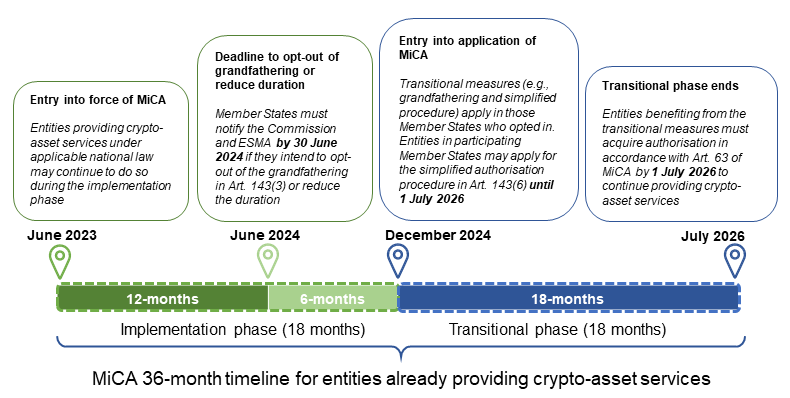
MiCA entered full application across the European Union on July 1, 2026, ending the transition period for crypto firms. Only a small fraction of groups are authorized, and Binance remains outside the licensed list after withdrawing its Greek application and warning EU customers it must restrict services without approval.
MiCA is now in full application across the European Union, ending the transition period for crypto-asset service providers that had been operating under earlier national rules.
The change took effect on July 1, 2026, and it creates a clear dividing line: firms with the relevant authorization can continue serving EU customers, while firms without it must stop operating or restrict themselves to orderly wind-down work, including helping clients transfer or withdraw funds.
A new EU rulebook takes hold
MiCA, the bloc’s unified crypto framework, was built to replace a fragmented national approach with one common authorization regime. From today, access to the European market depends on holding a licence recognized under the new system.
The first live list under the regime shows how selective the market remains. Coverage from the Financial Times said 244 digital asset groups were allowed to serve EU customers from July 1, while 1,738 would have to cease operations. Spanish reporting put the number of authorized entities at around 250.
That gap matters because it turns MiCA into more than a compliance milestone. It is now a market filter that decides which platforms can stay open, which must pause, and which must prepare an orderly exit.
Binance is the biggest absence
The most closely watched omission is Binance. The exchange does not appear on the authorized list at this stage, making it the most visible large operator still outside the regime’s licensed group.
That absence follows a series of warning signs in late June. Binance withdrew its Greek licensing application and said it would seek authorization in another EU country, but not in time for the July 1 deadline.
The company has also warned EU customers that, without a MiCA licence, it must restrict services. Financial Times reported that Binance told customers it would stop providing services in the region because it had not obtained the required licence.
What unlicensed firms must do
The new rules are not limited to a paper deadline. ESMA has urged unlicensed crypto platforms to prepare an orderly wind-down, stop taking new EU customers, cease advertising, and limit activity to what is needed to liquidate or safeguard client assets.
That guidance gives regulators a template for how to handle firms that are still outside the authorization process. It also sets expectations for customer treatment, especially around fund transfers and withdrawals.
For clients, the practical effect is immediate. Platforms without a licence cannot assume uninterrupted service in the EU, even if they are still trying to complete the authorization process.
An uneven rollout across the bloc
The transition to MiCA has been uneven across member states. National regulators have moved at different speeds, producing a patchwork of approvals that still leaves many firms waiting.
The Spanish coverage cited in the research said about 250 entities have now been authorized, with 21 in Spain, while Germany is leading the licensing count and Greece has not granted any approvals in this phase.
That unevenness helps explain why some firms remain active while others face restrictions. The regime is now uniform in law, but the licensing process has not been completed at the same pace everywhere.
What happens next
The immediate question is how fast national regulators enforce the new requirements against firms that are still unlicensed.
Another open issue is whether Binance will secure a new licensing route in another EU country after abandoning its Greek application. For now, the company remains outside the authorized set and must operate within the limits set for unlicensed providers.
The broader consequence is likely to be market consolidation. Firms that already have authorization gain an advantage, while platforms that cannot meet the new standard may lose EU customers, shift assets, or exit the market altogether.
For the European crypto industry, July 1 is not just a regulatory date. It is the start of a new operating model built around supervision, licensing, and a narrower field of approved competitors.
Revision note
Initial automated publication with expanded chronology and regulatory context.