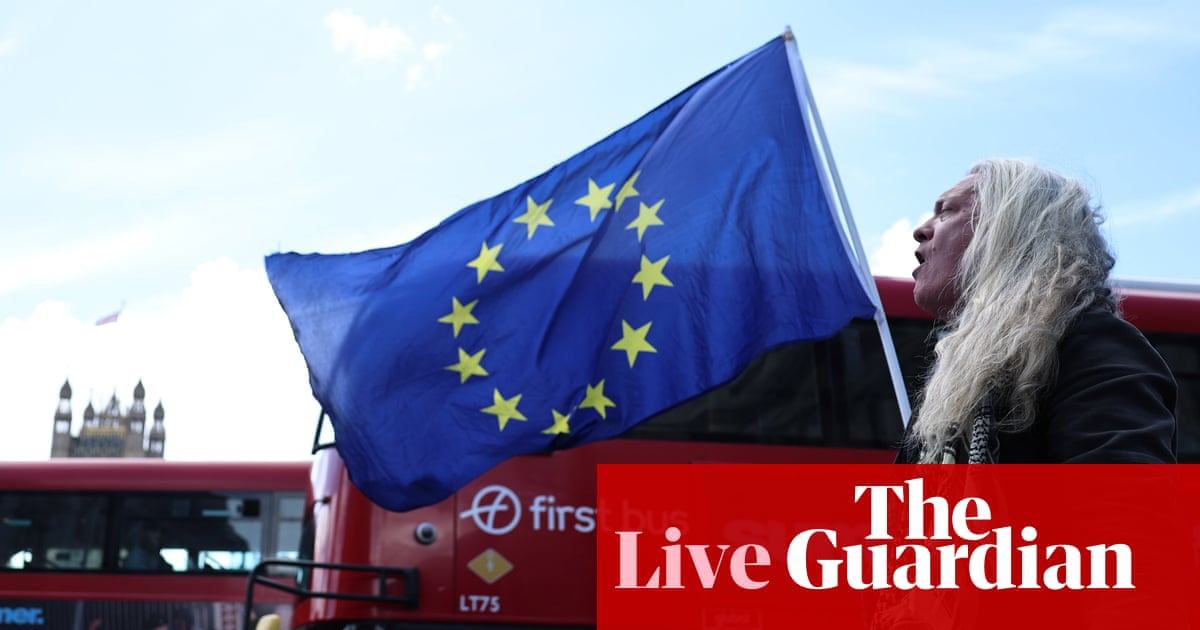
David Frost has urged Andy Burnham to avoid much of Keir Starmer's EU reset if he becomes prime minister, warning against closer alignment on food standards, emissions trading and electricity.
David Frost has urged Andy Burnham to abandon much of Keir Starmer’s EU reset if he becomes prime minister, as Labour’s leadership turmoil threatens to reshape the UK’s post-Brexit approach to Brussels.
Speaking at a UK in a Changing Europe conference on Tuesday, the former Brexit negotiator said the next Labour leader should not simply continue the reset agenda developed under Starmer. He warned that the UK should avoid becoming a “rule taker”.
Frost singled out sanitary and phytosanitary rules, emissions trading and electricity alignment as areas he thought Britain should not pursue. His comments amount to a direct challenge to the direction Starmer set out before his resignation.
Labour leadership transition
The intervention came as Burnham’s path to the Labour leadership was being treated as increasingly likely in Westminster. Guardian reporting on Tuesday said allies of Starmer were urging a swift transition to Burnham, while other Labour figures were debating whether anyone should challenge him.
That uncertainty matters because it leaves the UK-EU reset without a stable political landing zone. A change in prime minister would not just alter the personnel in Downing Street; it could also affect the substance and pace of negotiations with Brussels.
The broader political backdrop is Starmer’s resignation and the fast-moving scramble around who will lead Labour next. Burnham is widely viewed as the likely successor, but the exact timing and mandate of any transition remain unsettled.
What the reset covered
Starmer had previously set out a reset approach that tried to move the UK beyond the most politically charged parts of Brexit. At the G7 summit on June 17, he said Britain should not be “looking backwards” to Brexit and confirmed plans for an EU summit on July 22.
That summit has since been postponed, adding another layer of uncertainty to the timetable. The delay means there is still no confirmed political moment for landing any agreement on the reset agenda.
The issues in play are sensitive because they touch on trade frictions, regulatory alignment and other areas where the UK and EU can cooperate without reopening the wider Brexit settlement. Talks have included food and drink rules, carbon pricing alignment and youth mobility.
Frost’s remarks suggest he would push a Burnham-led government to pull back from closer alignment on those fronts. His warning was not about ending talks with the EU altogether, but about stopping the UK from binding itself too closely to Brussels’ systems.
What Frost is warning against
The former negotiator’s specific objections were to SPS, ETS and electricity alignment. In practice, those areas would shape how far the UK follows EU standards on food and animal products, carbon markets and energy cooperation.
His criticism reflects a familiar hard-Brexit argument: that closer alignment may reduce friction, but only at the cost of Britain accepting rules it does not help make. That is what he meant by warning against becoming a “rule taker”.
The timing is important. Starmer had only recently restated the reset direction, but the leadership upheaval now gives opponents of that approach a chance to argue for a different course before any deal is locked in.
For Burnham, if he does move into Downing Street, the question will be whether he inherits Starmer’s framework, redraws it, or drops parts of it altogether. Frost’s intervention is an early attempt to shape that answer.
What happens next
For now, the main confirmed developments are Frost’s public warning, the delayed summit and the political uncertainty around Labour’s leadership. Together they leave the UK-EU timetable in flux.
The next signs to watch are whether Burnham publicly accepts or rejects Frost’s advice, whether the EU reschedules the summit with the same negotiating goals, and whether the leadership transition clarifies the government’s mandate on Europe.
Until then, the future of the reset remains open. The policy questions are familiar, but the politics around them have changed quickly enough to make the next phase of UK-EU relations far less predictable than it was a week ago.
Revision note
Initial automated publication.