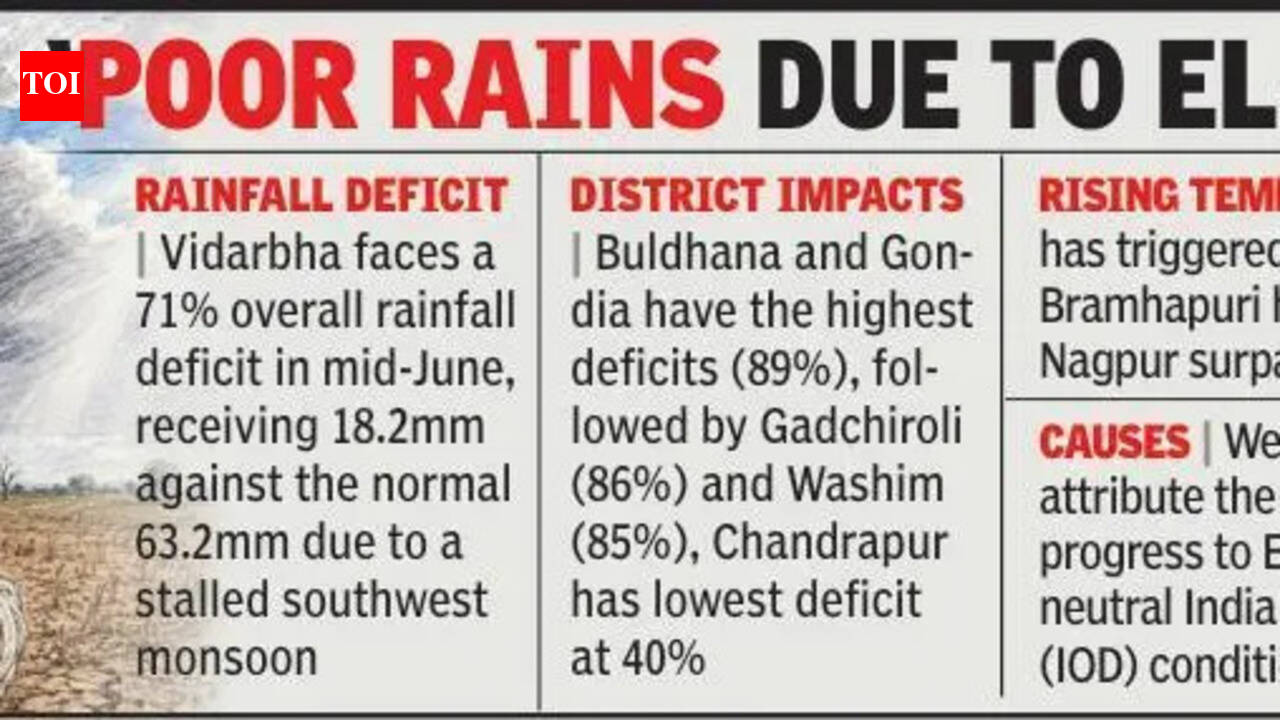
Vidarbha is facing a steep June rainfall deficit, with local reporting putting the region 71% below normal as the southwest monsoon remains delayed and heatwave conditions persist in parts of eastern Maharashtra.
June deficit widens
Vidarbha is moving through mid-June with a steep rainfall shortfall and renewed heat. Local reporting on June 18 said the region had received 18.2 mm of rain so far this month against a normal 63.2 mm, leaving it 71% below average.
The gap matters because Vidarbha is a rain-dependent farming belt where early-season moisture helps decide whether Kharif sowing can begin safely. A delayed monsoon quickly turns into an agricultural problem, not just a weather one.
Nagpur district has also stayed short of normal rainfall. The June 18 report put it at 29.5 mm against a normal 55.2 mm, a 47% deficit.
Several districts were described as much worse off. Buldhana and Gondia were reported at 89% below normal, Gadchiroli at 86% and Washim at 85%, showing how widespread the dry spell has become.
Heat returns after brief relief
The rainfall deficit has been accompanied by a fresh rise in temperatures after brief pre-monsoon showers earlier in June. Reporting on June 18 said temperatures climbed above 40C in multiple districts, with Bramhapuri reaching 42.8C.
A June 17 report showed the same pattern a day earlier. It said Bramhapuri had reached 42.2C, Gondia 42.0C, Akola 40.9C, Wardha 40.9C and Nagpur 40.0C.
The India Meteorological Department was reported to have kept a heatwave alert in force for parts of Vidarbha, including Nagpur, as the monsoon remained slow to advance.
Monsoon delay and official outlook
The monsoon delay has been visible since at least June 15, the expected onset date mentioned in the reporting. A June 17 report said the southwest monsoon had missed that date for Vidarbha and could still take another four to five days to move further into Maharashtra.
That report also said Amravati was the only district to record notable rain in the previous 24 hours, with 15 mm, while other districts remained largely dry.
The Regional Meteorological Centre in Nagpur said the rainfall seen in some places was mainly due to local convection rather than a broad monsoon spread. Forecast in-charge Pravin Kumar was quoted as saying monsoon rainfall activity remained weak even in areas already covered.
Farm and fodder risk
For farmers, the timing is critical. The main risk is that sowing could begin before sustained rain arrives, leaving seeds exposed to dry soil and forcing re-sowing if the monsoon stalls again.
That makes the current phase especially sensitive for Kharif planning across Vidarbha. The region has already shifted from brief early-June relief back into heat and dryness, narrowing the window for safe planting.
A separate June 17 Economic Times report added a livestock angle to the dry spell. It said Maharashtra had advised farmers to plan for fodder shortages because El Nino could worsen dry-spell risk and affect agricultural cycles and feed availability.
What to watch next
The immediate question is whether the monsoon advances into Vidarbha within the next few days and whether rainfall becomes sustained enough to improve ground conditions before farmers commit seed to the field.
Another key check is whether district-level rainfall deficits begin to narrow or whether the shortfall deepens further in the next official update.
Heatwave warnings are also likely to remain in focus. If temperatures stay above normal while rain remains patchy, pressure will continue to build on people, livestock and agricultural planning across the region.
,Revision note
Initial automated publication.