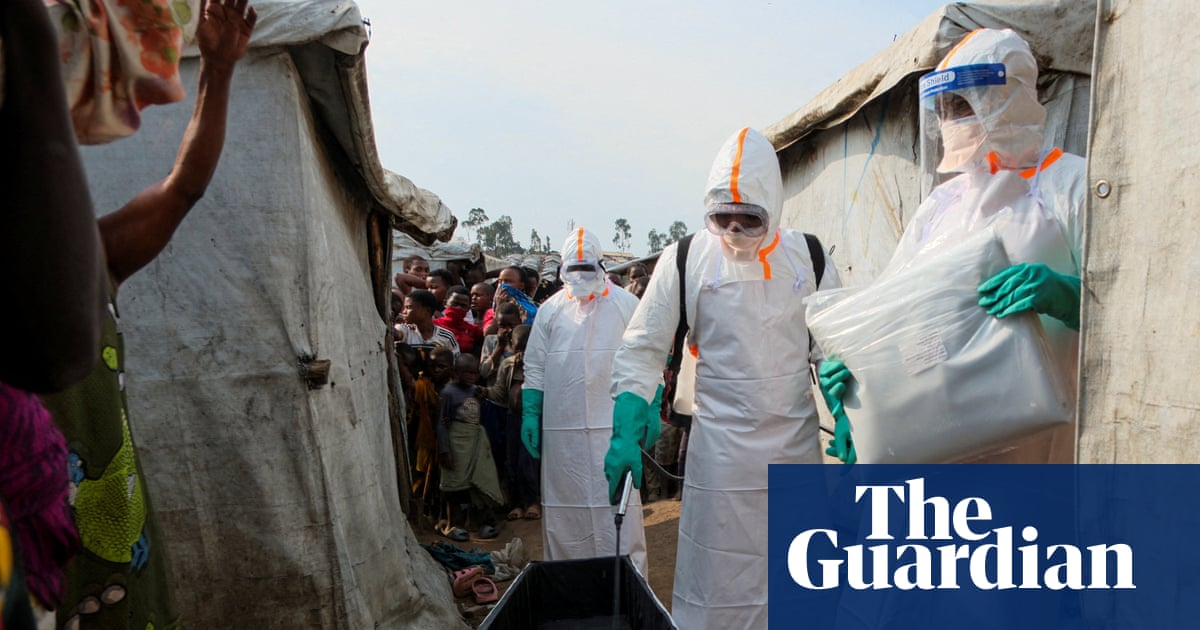
Africa CDC says 297 people who tested positive for Ebola in the Democratic Republic of the Congo are unaccounted for, a warning that conflict and displacement are making contact tracing far harder in eastern outbreak zones.
Africa CDC says 297 people who tested positive for Ebola in the Democratic Republic of the Congo are unaccounted for, deepening concern that conflict and displacement are breaking the outbreak response in eastern parts of the country.
Jean Kaseya, the Africa CDC director-general, said the missing patients are making contact tracing harder at a time when health workers are already struggling to reach communities caught up in fighting and mass movement.
The warning adds a new layer to an outbreak that has already shown signs of strain. Public-health teams are not only trying to contain a growing caseload, but also trying to locate people who tested positive and then slipped out of reach.
Outbreak totals are still rising
As of the June 26 report, the DRC had recorded 1,118 confirmed Ebola cases and 291 deaths in the outbreak. The current episode is caused by the Bundibugyo strain of Ebola.
Those figures matter because the missing patients are counted against an outbreak that is still active and still expanding. Health officials do not know whether the 297 people are still alive, still infectious, or lost to follow-up as records and access break down.
That uncertainty is exactly what makes the situation dangerous. Ebola control depends on isolation, contact tracing, and monitoring during the 21-day incubation period, and each gap in the list of patients weakens that chain.
Conflict and displacement are disrupting the response
The problem is especially severe in eastern DRC, where armed conflict has pushed many people from their homes. Reporting cited more than 1 million displaced people living in camps that health workers cannot access.
Those access barriers slow surveillance, delay case investigation, and make it harder to find contacts before they can spread infection further. They also mean that even when cases are confirmed, follow-up can collapse once patients move or lose contact with health teams.
Kaseya’s warning reflects a broader operational failure: if health workers cannot enter camps or keep track of movement between communities, they cannot reliably map transmission chains.
The chronology changed this week
The latest warning follows earlier reporting that the outbreak had already crossed an important threshold. On June 22, authorities said confirmed cases had topped 1,000 and deaths had reached 254, while contact tracing remained incomplete.
By June 26, both the outbreak totals and the public-health concern had grown. The new Africa CDC warning did not just describe a larger outbreak; it flagged nearly 300 Ebola-positive people who could not be located.
That shift matters because control measures only work when cases are visible. Once patients are missing, health officials lose track of who may still need treatment, who may have exposed others, and where the next cluster could emerge.
Cross-border risk is already real
The outbreak has already produced consequences beyond Congo’s borders. France recently confirmed Ebola in a doctor who had returned after humanitarian work in the DRC.
French authorities isolated the doctor on arrival and began contact tracing under a 21-day monitoring requirement. That response mirrors the same incubation window health officials use to watch exposed people in Congo.
The DRC government has also told people who have been in affected provinces to wait 21 days before traveling onward. The rule is meant to reduce the risk of exporting infections while tracing remains incomplete.
What health officials are watching next
WHO-backed modelling cited in the reporting projected as many as 8,210 cases and 1,420 deaths by mid-September, with a 70% chance of spread to South Sudan. That is a projection, not a certainty, but it highlights how serious the surveillance gaps could become.
The immediate operational question is whether Africa CDC or the World Health Organization will publish a more detailed situation report with updated line lists and better tracing coverage. Health teams will also be watching for added field capacity, treatment-center support, and access to displacement camps.
Neighboring countries are another point of focus. If the outbreak continues to expand and tracing remains incomplete, screening and travel rules could tighten further across the region.
For now, the central concern is simple: nearly 300 people who tested positive for Ebola cannot be found, and in a conflict zone with limited access, that leaves public-health teams looking for transmission they cannot yet see.
Revision note
Expanded initial publication with full chronology, outbreak context, cross-border risk, and response implications.